
Follicular Unit Excision
Follicular Unit Excision (FUE) is a donor harvesting technique in which follicular units are removed individually from the scalp in a single-step procedure. In contrast, FUT is a two-step method: a strip of tissue containing numerous follicular units is first removed, and the individual follicular units are then dissected from this tissue. After healing, FUE produces multiple small circular scars throughout the donor area, while FUT results in a single linear scar. However, unlike FUT, FUE generally allows the hair in the donor region to be clipped somewhat shorter without revealing the scar pattern.
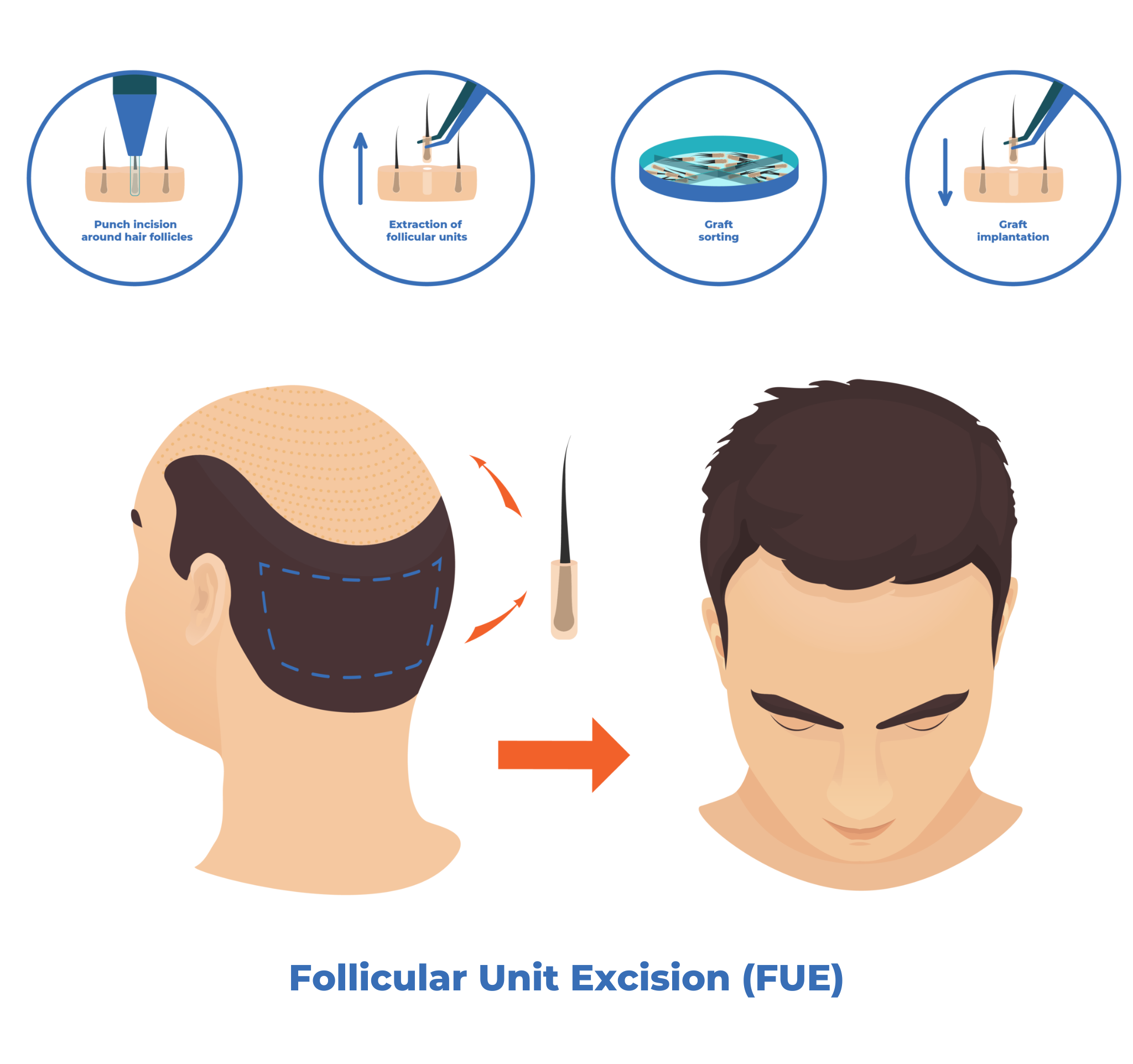
FUE is the preferred approach for patients with less severe hair loss and who prefer shorter hairstyles, who require a smaller number of grafts, or who have insufficient scalp elasticity to safely undergo FUT. Moreover, with careful planning and patient selection, a single FUE session may provide advantages, including the possibility of temporary cosmetic benefit without committing the patient to a staged or long-term surgical plan. This can allow certain individuals who would otherwise not be ideal candidates for transplantation to receive a smaller, more tailored intervention.
However, FUE also has important disadvantages. First and foremost, in order to obtain a large number of grafts, most practitioners need to harvest grafts outside of the safe donor zone. In the long run, this leads to punctate scars becoming visible and to loss of the non-permanent hairs transplanted into the recipient area. Alternatively, it can lead to overharvesting within the safe donor zone, creating visible density gradients in the donor area, often referred to as the windowing effect, or causing diffuse thinning across the donor region in either the short or long term, depending on the degree of overharvesting.

Donor harvesting has a higher risk of exceeding the safe donor as the area of balding expands
